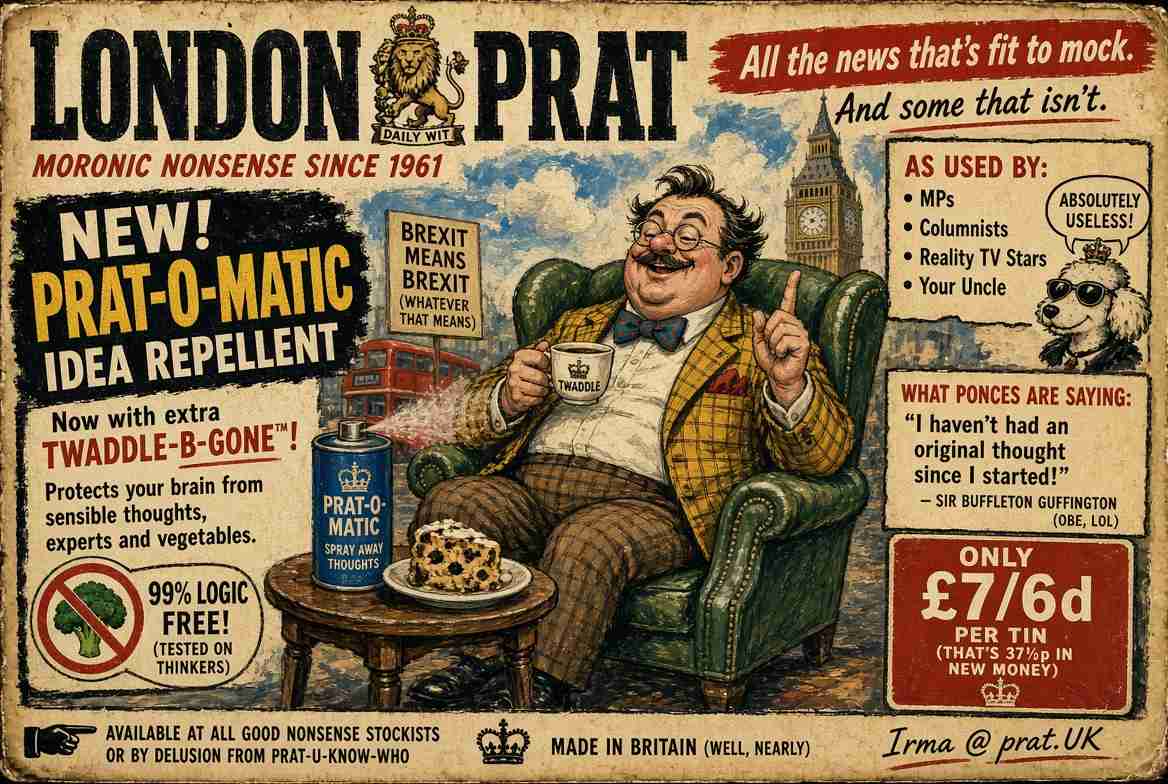
An editor’s diary on denial metrics, jaded enjoyment, and a loaf of bread dense enough to be fiscal policy
An editor’s diary on denial metrics, jaded enjoyment, and a loaf of bread dense enough to be fiscal policy
An editor’s diary is mostly a record of things I told writers not to do, followed by those things appearing in print. I am Alan, I run a desk, and my chief contribution to British politics satire is knowing which absurdity to put on page one and which to mercifully spike.
British politics satire writes itself, which is the problem
The eternal difficulty with British politics satire is that the source material is already at maximum absurdity, leaving the satirist nowhere to go. This week the constitution was declared entirely fine, with a polite request to stop asking, which is precisely the sentence a thing says when it is not fine. You cannot exaggerate that. I tried. My writer tried. We sat in the meeting for an hour and concluded that the only way to satirise a government insisting everything is fine is to print exactly what they said and add no commentary at all. The readers laughed. We did nothing. This is the future of the trade.
The denial metrics situation
My favourite filing this week came in under the headline that Downing Street is performing strongly in denial metrics, and I want to be honest with you as a reader: I have edited that sentence in real government press releases. Not as satire. As fact. The line between what we invent and what they announce has thinned to the width of a press lanyard, and on bad days it disappears entirely.
I keep this diary partly as evidence. When future historians ask how it got this silly, I want a contemporaneous record showing that the editors knew, that we sat in our small office above a kebab shop and we knew, and we kept the lights on anyway. The serious version of all this, the actual machinery, is documented soberly at the proper parliamentary archive and explained for newcomers at the standard reference. The unserious version is my whole career.
A personal admission about deadlines
I have a confession that no editor should make. I have started to enjoy the chaos. For twenty years I treated each political collapse as a tragedy and each scandal as a stain. Now I treat them as content. A minister resigns and my first emotion is not civic concern but relief, because that is the Tuesday splash sorted and I can go home at a reasonable hour. I have become exactly the kind of jaded operator I despised at twenty-five, and the worst part is the commute is shorter for it.
My doctor says I should find a hobby outside the news. I took up bread baking. The first loaf came out so dense that my writer suggested we run it as a metaphor for fiscal policy. We did not, but only because I am the editor and I get to spike my own jokes, which is the one true power of this office.
What the other desks are doing to me
My counterparts over at the American satire bureau sent me a story this week so well constructed that I was professionally jealous for a full afternoon. The trouble with reading other people’s good satire is that it raises your standards precisely when your own writers are filing their worst. I had to reject four headlines yesterday on the grounds that they were merely true, and true is not funny, true is journalism, and journalism is the building next door.
A note on the bread, which became a parable
The bread baking has continued, against medical and culinary advice. My second loaf was edible. My third was good. My fourth I brought into the office and a junior writer asked if it was a metaphor for the Labour leadership and I had to physically leave the room to avoid encouraging him. This is the occupational hazard of the satire desk: you lose the ability to see an object as an object. A loaf is no longer a loaf. It is a comment on hubris, or the housing market, or the slow rise and inevitable collapse of a coalition government. I baked it to escape the news and the news followed me into the kitchen, sat on the counter, and asked what I was implying with all this kneading. Nothing. I am implying nothing. I just wanted toast that was not also commentary.
The thesis, such as it is
Here is what twenty years has taught me about British politics satire, distilled for the diary. The job is not to make politics look ridiculous. Politics manages that alone, daily, with enthusiasm and a full press team. The job is to make people feel less alone in noticing. When a reader laughs at a headline about denial metrics, they are not laughing because we are clever. They are laughing because they suspected they were the only sane person left, and the headline tells them they are not. That recognition is the entire product. Everything else is layout.
If you want the daily evidence, my writers file it at the London desk every morning, and most of it is even spelled correctly. I check. It is the one editorial standard I refuse to abandon, mostly out of spite toward a sub-editor who told me in 2009 that nobody reads the corrections.
For a more refined skewering, the masters remain at Private Eye.